« The Devil You Know is Better… | Home | A Life Better Left Unexamined »
To Live and Die in West Texas
By bukkhead | November 19, 2007
FILM REVIEW: ‘NO COUNTRY FOR OLD MEN’
Written by Ethan Coen and Joel Coen, Based in the Novel by Cormac McCarthy
Directed by Joel Coen and Ethan Coen
Rated R
122 mins.


 When the Coen brothers direct a movie based on a novel by Cormac McCarthy, you really have no idea what to expect. This is by design. From McCarthy we’ve seen such diversity as All the Pretty Horses and Blood Meridian. No Country For Old Men is as different from those as the Coens’ Fargo is from their Barton Fink. And yet, for all the variety and unpredictability of a Coen production, they are at their best when the pacing is slow and the lenswork is gritty. And so their collaboration with McCarthy’s novel is the perfect marriage.
This is a story set in Texas, near the border. Llewelyn Moss, out hunting, comes across the remains of a drug deal gone bad. Bloated bodies and shot-up trucks litter a patch of scrubland. Llewelyn ignores a badly wounded man dying of dehydration and ably tracks the lone getaway, the one with the money, and finds him also dead. This is the beginning of the end.
Because in proper Coen fashion, it’s Llewelyn’s conscious that proves to be his undoing, as he returns to the scene with water for the dying man. In as much as the Coen’s deliver an unpredictable movie, there are nevertheless principals that must be adhered to. Enter Anton Chigurh.
In any other movie Chigurh would be simply a force of a nature, a psychopath with a singular focus and a peculiar hair cut. But the combination of Coen, McCarthy, and actor Javier Bardem moves Chigurh along that fine line: he is almost, but not entirely, blood thirsty, almost, but not entirely, cruel. He’s the balancing force, an equal on different ground to Llewelyn; both are resourceful, determined, and Texas-grit tough. But whereas Llewelyn is man who knows how to survive in the desert, Chigurh is a man who knows how to kill survivors.
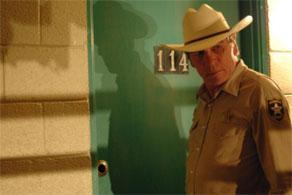
Tommy Lee Jones, as Sherriff Bell, is the mediator between these two hunters, also a man born from the Texas dirt, but while Llewelyn fights to survive in it, Bell merely blends in, as solid and tired as the plains he polices.
The Coens juxtapose long, slow scenes with moments of brief and sharp violence. Chigurh’s weapons are as iconic as he is: a silenced shotgun, and hydraulic ram (the kind they use to kill cattle). Tension is built by showing Chigurh walking slowly, the lens aimed at his waist so that we can see him carrying the tools of his trade. They are also the evidence of his determination; proof, in Sherriff’s Bell’s tired eyes, that we are indeed beset upon by a dismal tide.
The Texas scrubland, close to the border, should be warm, even hot, but the Coen’s exteriors are cold, indifferent, unforgiving. Interiors, when not exuding impenetrable darkness, are full of windows, with full views of the hostile outdoors. It’s this mixture of existentialism and fate that we’ve come to expect from the Coen brothers, and appreciate from McCarthy—even though we can never see the end these tools will wrought.
(An edited version of this review was printed in the Newport Mercury.)
Topics: Movies | No Comments »