« One Way Or Another, Heads Will Spin. Or Explode. Or Both. | Home | It Was a Dark and Stormy Night… »
Money for Nothing
By bukkhead | March 24, 2008
FILM REVIEW: ‘THE COUNTERFEITERS’
Written by Stefan Ruzowitzky, based on the book by Adolf Burger.
Directed by Stefan Ruzowitzky
Rated R
98 mins.

 Opening shot: the sea, symbol of fortune and destiny. A man sits on the beach, contemplating his past… or his present. Each shapes the other: the past leads us to our present, of course; the present contextualizes our memories of the past. It’s one thing to survive; it’s another thing to have survived—what’s next?
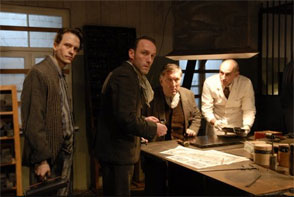
In order to contextualize what’s next, The Counterfeiters tells us the story of Operation Bernhard, Nazi Germany’s plan to produce counterfeit documents and foreign currency. Enlisted—actually, pressed—into this project is Salomon Sorowitsch, the “King of the Counterfeiters.” Installed at Sachsenhausen with a team of printers, collotype specialists, and other craftsmen, “Sally” and his fellow Jewish prisoners set about the delicate task of balancing survival with success.
This is the chief tension of the film. On the one hand, these “Fälscher” have it pretty good, compared to other concentration camp inmates: comfortable beds, adequate clothing, even days off and the occasional entertainment. But they are still Jews, still subject to the cruelty of the SS guards. If they do not produce results, they risk extermination. If they succeed in all measures, they will also be terminated, discarded.
Amongst the prisoners this tension is manifest in, for example, Zilinski, who would have everyone do exactly as they are told, and Burger, who would gladly martyr himself and his fellow Jews to symbolically resist the Nazi war efforts. Sturmbannführer Herzog, who runs the camp, uses a more gentle approach to coercion, while Sorowitsch is driven as much by pride as the need to survive. But no man is so simple—even Herzog will use the threat of death to achieve his goals, and Sorowitsch, for being a “hardened criminal,” nevertheless adheres to a basic code of ethics.
Director Stefan Ruzowitzky uses a cramped, almost pinched film style to force these contrasting elements into constant juxtaposition. Colors are drab, evoking a compulsion to think in terms of black and white—until characters talk about how things would be “better with color.” Circumstances may appear cut-and-dried, easy to navigate when they are in black and white. But adding color reveals subtleties and nuances than can change a perspective entirely. There are no heroes, no villains, only forces, and survivors.
Films with historical settings have the luxury—and the burden—of a built-in context. We know that Germany lost the war, but who won? As Sorowitsch sits at a Monte Carlo card table, contemplating his past, did he win because he successfully counterfeited the dollar, or because he stayed alive? Did fortune make him a master craftsmen so that he would survive the concentration camp, or was he put there so he could at last complete his greatest masterpiece?
Closing scene: the sea, symbol of a world too large for one man to have much of an effect upon. A couple dances on the beach, merely enjoying their present. Money, for all it’s worth, is actually quite worthless, whether gains be ill gotten or richly deserved.
(This review was printed in the Newport Mercury.)
Topics: Movies | No Comments »